Guillermo Reyes

Turning CO₂ and biomass into materials industry can make and investors can back.

For more than fifteen years, across Chile, Finland and the United States, I have worked where CO₂, biomass and industrial scale-up meet, turning difficult materials problems into technologies that can be transferred, funded and manufactured.

15+ years across R&D, industry and academia
€3M+ in competitive funding secured
9 inventions, 2 transferred to industry

What I work on

Four lines of work, all circling one problem: how a material's structure decides whether it survives contact with a production line.

Lab performance is rarely what holds a material back. What holds it back is poor fit with manufacturing, markets and adoption, so I design for that fit from day one.

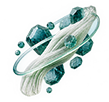
Cellulose mineralisation illustration

Mineralisation in cellulose

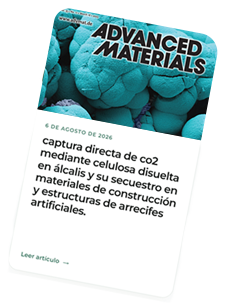
Carbonates grown inside a cellulose scaffold, so the material stores CO₂ as part of its own architecture rather than as an additive. In parallel, electrochemical mineralisation of industrial residues such as slags and ashes.

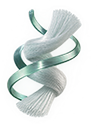
Fibre spinning and regeneration illustration

Fibre spinning and regeneration

Cellulose dissolved in ionic liquids, alkali and NMMO, then regenerated through dry-jet wet and coaxial spinning into fibres and hollow filaments. Most of what I know about scale-up came from watching this step fail.

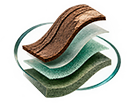
Engineered bark composite illustration

Bark as an engineered composite

Spruce bark is not a cellulose feedstock with inconvenient impurities. It is a hierarchical composite of lignin, tannins and suberin, and its design logic can be reprogrammed into fibres and foams.

Biohybrid construction materials

Construction materials in which biology does part of the manufacturing, from biofabricated panels to biologically guided mineralisation, so that buildings store carbon rather than emit it. This is the focus of my current European consortium work.

How I evaluate a technology

Whether I am evaluating proposals for the European Commission, selecting consortium partners or assessing a deep tech company, four questions guide my judgement.

Is the science real?

TRL claims checked against publications and project history, not pitch decks.

Is the IP defensible?

Ownership, prior disclosure and freedom to operate.

Are the scale-up assumptions credible?

On energy, feedstock and adoption.

What is the bear case?

And what value remains if it plays out?

Where the work has gone

Research leadership at VTT, scale-up at a Bay Area start-up, collaboration with a Chilean biomaterials venture, and a chemical engineering programme built from its first year.

2024to present

Principal Scientist and EU Project Coordinator

VTT Technical Research Centre of Finland

Researcher on MYCO-PAN, a VTT-coordinated New European Bauhaus project on biofabricated construction panels, launched in September 2026. Coordinating REBUILD, a 16-partner Horizon Europe proposal for the 2027 call on biohybrid construction materials (around €6.5M), with Fraunhofer, Empa, Holcim, Aalto, SINTEF and VITO.
2025to present

Scientific Collaborator

Bioluméa, Concepción, Chile

Scientific collaboration with a Chilean biomaterials start-up turning forest and coastal biomass into CO₂-capturing additives for coatings and cosmetics.

Visit Bioluméa
2023to 2024

Director of Materials Innovation

Rubi Laboratories, Bay Area

Promoted to Director within four months. Led the CO₂-to-textile scale-up from R&D to pilot and got the spinning line running for the first time.

2016to 2023

Visiting Professor (Fellowship) and Postdoctoral Researcher

Aalto University, Finland

Researcher on BioELCell, an ERC Advanced Grant project, working on nanocellulose, sustainable textiles and CO₂-capture biomaterials with UBC, the Max Planck Institute of Colloids and Interfaces and UPM. Inventions from this work were transferred to UPM-Kymmene and Lignum Medical.

2012to 2020

Founding Lead and Programme Director, Chemical Engineering

Universidad del Bío-Bío, Chile

Led the creation of the Chemical Engineering programme in 2012 as Assistant Professor and directed it from 2018 to 2020: secured national accreditation from the Ministry of Education, managed an annual budget above CLP 100 million with more than twenty staff and four hundred students, and worked with industrial partners ENAP, ARAUCO and CMPC. Supervised more than thirty student theses.

Technology transferred

Nine inventions and three patent applications. Two have been transferred to industrial partners.

UPM-Kymmene. A bio-inspired route to dissolving cellulose under alkaline conditions. Patent application: CN117980547A

Lignum Medical Oy. An auxetic nanocellulose mesh for tissue growth and filtration. Patent application: PCT/FI2021/050198

Writing, talks and credentials

Peer-reviewed papers including first-author work in Advanced Materials, Green Chemistry and Carbohydrate Polymers, and a co-authored paper in JACS. Full and current list on Google Scholar.

Talks

  • Workshop, Renewable Materials Conference, Siegburg 2026
  • Keynote and Golden Crop Award, Renewable Resources and Biorefineries, Turku 2025
  • Keynotes at ATCP and CIADICYP, Chile 2024

Credentials

  • Registered Expert Evaluator, Horizon Europe 2026
  • Certified Project Manager, IPMA Level C 2026
  • U.S. O-1 visa for extraordinary ability 2023
  • PhD, Chemical Engineering, Universidad de Concepción 2013
  • BSc, Chemical Engineering, Universidad Pontificia Bolivariana 2007
Guillermo Reyes

Contact

If you are building, funding or scaling materials made from CO₂ and biomass, I am happy to connect.

Tampere, Finland · Working in English and Spanish Guillermo Reyes, PhD · Back to top ↑